
Avanzado
Advanced minor surgery and demanding anatomical sites
For people who already suture daily and want a different class of result.
€79 one payment
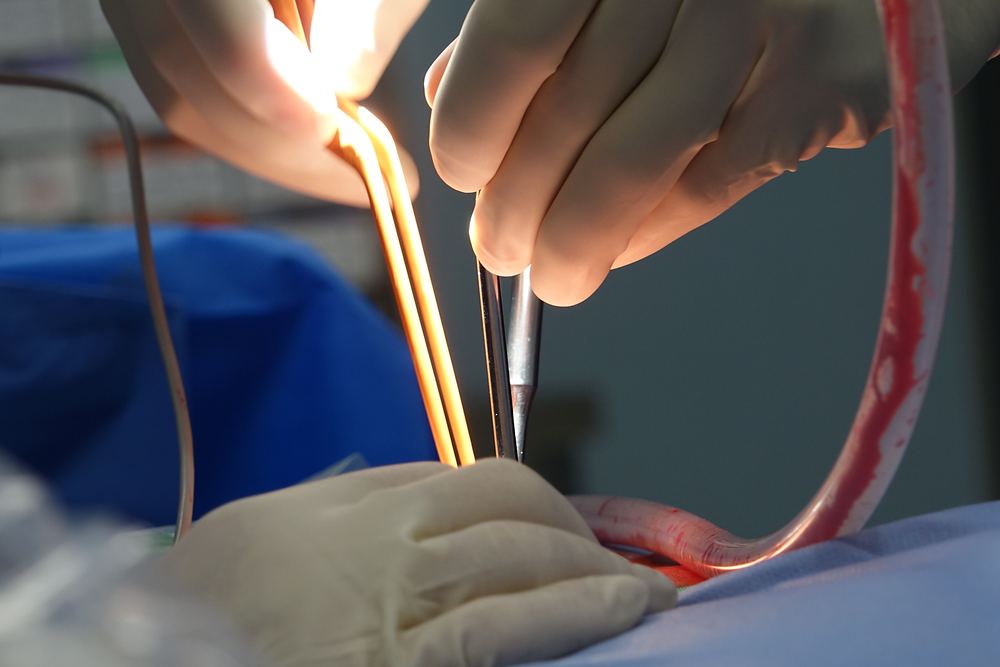
The Avanzado level works on the difficult material: the wound under tension that cannot be pulled shut, the face, the eyelid, the lip, the ear, the nail bed, the burn and the wound that needs negative pressure.
It is the most hands-on of the three. The final assessment is not a quiz: it is a recording of your own technique, marked against a published rubric.
Prerequisites: Intermedio level completed, or demonstrable equivalent experience.
What you will be able to do
- Close in layers and distribute tension to prevent dehiscence and a widened scar.
- Design an advancement flap and a simple Z-plasty.
- Apply the specific principles of face, lip, eyelid and ear.
- Repair a nail bed and triage hand wounds.
- Assess burns and perform advanced debridement.
- Indicate and set up negative-pressure wound therapy.
- Self-assess your technique against an objective rubric.

Syllabus
Module 1 — Layers, tension and plasties
Layered closure, advancement flap and Z-plasty.
- Layered closure and tension management — Eliminating dead space, the buried dermal stitch and distributing tension so the scar does not widen.
- Advancement flap and Z-plasty — Basic geometry of local flaps, relaxed skin tension lines, and redirecting a contracted scar.
- Module test
Module 2 — Demanding anatomical sites
Face, lip, eyelid, ear, nail bed and hand.
- Face, lip, eyelid and ear — Aesthetic subunits, the vermilion border, the lid margin and auricular cartilage: a one-millimetre margin of error.
- Nail bed and hand — Subungual haematoma, nail-bed repair, nail replacement and the essential functional examination of the hand.
- Module test
Module 3 — Burns and negative pressure
Advanced debridement and negative-pressure wound therapy.
- Burns and advanced debridement — Depth, total body surface area, burn-unit referral criteria, and enzymatic, sharp and autolytic debridement.
- Negative-pressure wound therapy — Indications, contraindications, setting up the system, pressures, change frequency and troubleshooting leaks.
- Module test
Module 4 — Complex cases and practical assessment
Integrative cases and video assessment against a rubric.
- Complex cases — Six real integrative cases with reasoned decisions, alternatives and the twelve-month outcome.
- Video practical assessment with rubric — You record your technique on a pad and mark it against a ten-criterion rubric published in advance.
- Module test
Module 5 — Lesiones relacionadas con la dependencia: categorizar y defender la categoría
UPP, LESCAH y lesiones por fricción con la clasificación GNEAUPP y EPUAP/NPIAP/PPPIA, incluidas la no clasificable y la lesión de tejidos profundos.
- UPP, LESCAH y lesiones por fricción: diagnóstico diferencial — Tres lesiones que se parecen y se tratan distinto. El mecanismo de producción es lo que las separa.
- No clasificable y lesión de tejidos profundos — Las dos categorías que más se documentan mal, y la regla de que una categoría no se deshace.
- Module test